Starship Earth
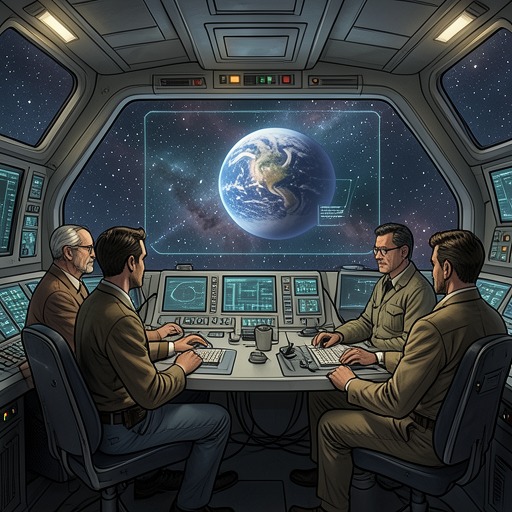
The Dark ForestStarship Earth is the independent five-ship civilization that emerges after the droplet destroys the combined human fleet. Its creation marks a decisive political and psychological break: the surviving crews remain part of humanity, yet can no longer depend on Earth as home, authority, or future. Carrying just over five thousand people into deep space, Starship Earth becomes at once a lifeboat, a country, and a possible second origin for human civilization.
Formation and Historical Circumstances
Humanity reaches the age of Starship Earth through a chain of escalating technological and military transformations. The completion of the space elevator and the breakthrough in controlled fusion encourage the world, but sober leaders recognize that these achievements are only the shoreline of space civilization. Fleet construction still requires spacecraft bodies, weapons, recirculating ecosystems, spaceports, and immense resources; even establishing the foundations may take a century. At the same time, the defense buildup drives heavily polluting industry, while environmental deterioration, desertification, climate anomalies, and food shortages culminate in the Great Ravine. The civilization that eventually leaves Earth is therefore produced by both technological advance and planetary crisis.
The strategic environment also makes secrecy and independent planning essential. The Trisolarans can observe Earth through continually arriving sophons, leaving humanity’s meetings, files, computers, plans, and deployments exposed. The Wallfacer Project is created because ordinary communication leaks every plan, while human deception remains a rare advantage against an enemy whose direct thought-based communication makes it deficient in camouflage and trickery. Starship Earth belongs to the wider response to this transparent and dangerous world: it is not simply an exploratory expedition, but a survival structure formed under conditions in which Earth itself has become vulnerable.
The Break from Earth
Seven remaining spaceships flee the Solar System in two groups: five ships made up of Natural Selection and its pursuers, and two survivors, Quantum and Bronze Age. The groups move on nearly opposite headings, separated by the sun and gradually increasing their distance from one another. On Natural Selection, Zhang Beihai receives the news that the combined fleet has been annihilated and immediately understands the consequence. The droplet remains in the Solar System, nine more droplets are expected within three years, and human civilization is predicted to collapse before the main Trisolaran Fleet arrives. The five ships therefore cannot return; their former home has become a death trap.
Zhang Beihai tells the assembled captains, officers, and soldiers that they must share a common will and accept that there is no way back. The approximately 5,500 crew members are compared to an infant severed from its cord and thrown into space, while Zhang’s composure steadies the formation and preserves its military discipline. His role is not merely operational. He supplies the emotional authority required by a population forced to exchange a planet for a collection of vessels, turning flight into a collective historical mission.
The new society receives its name from Dongfang Yanxu, who proposes Starship Earth because the ships come from Earth and may be the sole inheritors of Earth civilization. Zhang Beihai approves the name and declares that everyone is now a citizen of Starship Earth. The naming converts a desperate escape into a political beginning: the ships are no longer only a fleet in transit, but a world with citizens, responsibilities, and a distinct identity.
Political Status and Institutions
Starship Earth remains connected to humanity but cannot be politically subordinate to Earth or to the three fleets. Its assembly therefore determines that the five ships will constitute a totally independent country. The United Nations and the Solar Fleet Joint Conference respond with prolonged silence before sending a tacit blessing, a reaction that acknowledges the necessity of the decision without fully claiming or rejecting it.
This settlement divides the human world into three internationals: the ancient Earth International, the Fleet International of the new era, and the Starship International voyaging into the depths of the cosmos. Starship Earth has only slightly more than five thousand people, yet its small population carries what the narrative presents as the hope of human civilization. Its political independence is thus paradoxical. It is demographically tiny and materially fragile, but historically enlarged by the burden of preserving a human future beyond the immediate reach of Earth.
The Citizens’ Assembly becomes the central venue for imagining that future. In successive meetings, the inhabitants debate a constitution and social structure, draft laws, and plan the first election. Officers and soldiers of different ranks, as well as people from different ships, exchange views in an effort to construct a society rather than merely preserve a command hierarchy. The process gives the population an active role in founding its institutions, even though the society begins under military conditions and in permanent flight.
A Second Eden in Space
The people of Starship Earth initially respond to their new condition with creative excitement. They imagine the fleet reaching one star system after another and forming a core that will grow into a larger civilization. Increasing numbers call Starship Earth a second Eden, a second point of origin for humanity. The phrase expresses both hope and danger: the fleet appears to offer a fresh beginning, but its members must create social life inside a sealed technological environment while carrying the psychological wounds of abandonment and war.
That wonder does not last. The chief psychologist of Natural Selection, Lieutenant Colonel Lan Xi, heads the Second Civilian Service Department, an agency of psychologically trained military officers responsible for mental health during long voyages and battles. When the fleet begins its journey of no return, Lan Xi and his subordinates go on alert like soldiers facing an enemy attack. Their preparedness reveals that the greatest threat to Starship Earth is not only external destruction. Isolation, dependence on shipboard systems, conflict among crews, and the loss of spiritual ties to Earth can also destabilize the new society.
The later history of the surviving fleets confirms this concern. After the combined fleet is destroyed, Escapism reappears after two centuries of silence. A proposal in the European Commonwealth to choose 100,000 emigrants by nationwide drawing passes a popular vote, but those excluded from departure respond with widespread riots, and public opinion condemns Escapism as a crime against humanity. After the Battle of Darkness between surviving warships, the debate becomes more severe: people in space appear to suffer total spiritual alienation when their bonds with Earth are severed, prompting the fear that a successful escape would preserve neither human civilization nor human identity. The imagined result is named Negacivilization. Starship Earth therefore embodies both sides of the escape question: it is humanity’s most promising continuation, but also a test of whether civilization can survive the psychological meaning of leaving its planet.
Environmental and Civilizational Significance
Starship Earth develops within a civilization increasingly forced to treat the Solar System as an engineered defensive environment. After the space elevator is completed, human spacecraft begin establishing bases on Mars and the moons of Jupiter, while the strategic importance of Venus and Mercury leads to the narrowly approved test of a stellar hydrogen bomb on Mercury. The excavation of a shaft there becomes humanity’s first large-scale engineering project on another planet, but the work reaches only one-third of its intended depth before an unusually hard metal-and-rock layer makes further construction too slow and expensive. These projects show that the new civilization is not escaping material limits; it is relocating its struggle with them across planetary distances.
The same engineering logic appears in the Snow Project, which proposes using stellar hydrogen bombs and Neptune’s oil film to create clouds of space dust. The droplets would leave tracks as they passed through the manufactured clouds, allowing humanity to detect their movement. Such a plan turns planetary and stellar materials into instruments of surveillance and defense, linking Starship Earth’s existence to the broader transformation of the Solar System into a strategic landscape.
Starship Earth also stands as a response to the collapse of old political power. In the transformed world, Luo Ji is told that all great powers have declined and that no individual country has risen in their place. The new suprastate entity is the space fleet. Starship Earth carries this political transition to its furthest point: unlike a fleet that still serves an Earth-centered order, it becomes a sovereign society whose territory is mobile and whose future is inseparable from its vessels.
Its eventual possibility is deliberately left open. Zhang Beihai understands that Earth’s habitability is the product of a long interaction between its biosphere and natural environment and is unlikely to be reproduced on a distant planet. The choice of NH558J2 therefore leaves open the possibility that no hospitable world will ever be found and that human civilization may remain permanently aboard a starship. The present generation is sustained by the hope of an Earth-like destination, but the generation born aboard Starship Earth may be the first to accept a starship itself as civilization’s natural home.
Narrative and Thematic Role
Starship Earth gives concrete form to the book’s movement from planetary history toward post-planetary history. It is neither a simple victory over the Trisolaran threat nor a clean technological escape. It is born from defeat, carries the survivors of a destroyed fleet, depends on discipline and psychological care, and must invent laws while traveling through an environment where return is impossible. Its independence preserves human plurality, but its small population and uncertain destination expose how fragile that plurality remains.
The organization also redefines what counts as a country. Its citizens share a political identity without possessing fixed territory; its borders are the hulls of five ships; its historical inheritance is compressed into a population of roughly 5,500. In that sense, Starship Earth is a mobile archive and a living experiment. It carries Earth civilization forward while being forced to abandon the assumption that civilization must remain attached to Earth.
The contrast with Earth is finally material as well as political. Five years later, Luo Ji and Zhuang Yan visit a gravitational-wave antenna in northern China, a 1.5-kilometer-long, fifty-meter-wide cylinder suspended above a meadow made green by the system’s continuous emissions and localized rain. The antenna reflects the technological mystery of the Trisolarans and the continuing transformation of Earth, while Starship Earth represents the other response to the same crisis: not adaptation in place, but organized departure. Together, these futures show humanity divided among an old planet, a fleet-based international order, and a small independent society voyaging into the cosmos.